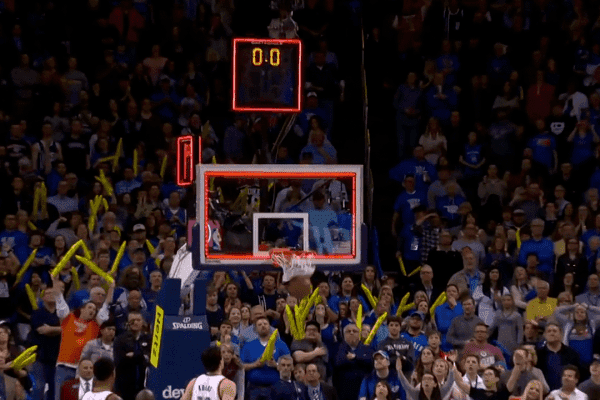
Market icon

NCAA Tournament: How many buzzer beaters?

Market icon

NCAA Tournament: How many buzzer beaters?

$15,342 Vol.

Apr 13, 2026
Polymarket

$15,342 Vol.

Polymarket

3 ou mais

$0 Vol.

31%

4 ou mais

$524 Vol.

18%

5+

$1,508 Vol.

3%

6 ou mais

$1,390 Vol.

13%

7 ou mais

$610 Vol.

1%

8+

$0 Vol.

3%

9 ou mais

$0 Vol.

1%

This market will resolve to “Yes” if the total number of buzzer beater shots scored to end any regulation 2nd half or overtime period during the 2026 Men’s NCAA Tournament equals or exceeds the listed number. Otherwise, the market will resolve to “No” If no buzzer beater is scored during the 2026 NCAA Tournament, the market will resolve to “No” A ‘buzzer beater’ is a made field goal that is scored at the expiration (leaving zero seconds on game clock) of any second-half or overtime period during the NCAA Tournament and ties the game or gives the shooting team the lead. First-half buzzer beaters will not count. Shots by a team that is already ahead or behind and that do not result in a tie or lead change will not count. Shots made at the end of the shot clock are not considered buzzer beaters. If the tournament concludes early, is shortened, or is truncated for any reason, the outcome shall be determined using available NCAA statistics for completed games. If the NCAA Tournament is cancelled, postponed after April 30, 2026, 11:59 PM ET, or if the exact number of “buzzer beaters” cannot be determined within that timeframe, this market will resolve to "No". The primary resolution source for this market will be official information from the NCAA and its official broadcast partners; however, a consensus of credible reporting may also be used.The 2024 NCAA Tournament has featured just one buzzer beater so far—Kylan Boswell's game-winning 3-pointer as time expired to lift Nevada past Dayton in the first round—with none in the subsequent second round, Sweet 16, or Elite Eight despite several nail-biters like NC State's near-miss against Virginia and Purdue's narrow escape over the Wolfpack. This scarcity reflects the rarity of true 0.0-clock winners amid March Madness' chaos, where close games abound but often resolve via late free throws or misses. With the Final Four underway featuring UConn, Purdue, Alabama, and NC State, traders eye the two semifinals and championship for potential surges, as heightened pressure and elimination stakes historically amplify dramatic finishes in late stages.

The 2024 NCAA Tournament has featured just one buzzer beater so far—Kylan Boswell's game-winning 3-pointer as time expired to lift Nevada past Dayton in the first round—with none in the subsequent second round, Sweet 16, or Elite Eight despite several nail-biters like NC State's near-miss against Virginia and Purdue's narrow escape over the Wolfpack. This scarcity reflects the rarity of true 0.0-clock winners amid March Madness' chaos, where close games abound but often resolve via late free throws or misses. With the Final Four underway featuring UConn, Purdue, Alabama, and NC State, traders eye the two semifinals and championship for potential surges, as heightened pressure and elimination stakes historically amplify dramatic finishes in late stages.

Resumo experimental gerado por IA com dados do Polymarket · Atualizado
This market will resolve to “Yes” if the total number of buzzer beater shots scored to end any regulation 2nd half or overtime period during the 2026 Men’s NCAA Tournament equals or exceeds the listed number. Otherwise, the market will resolve to “No” If no buzzer beater is scored during the 2026 NCAA Tournament, the market will resolve to “No” A ‘buzzer beater’ is a made field goal that is scored at the expiration (leaving zero seconds on game clock) of any second-half or overtime period during the NCAA Tournament and ties the game or gives the shooting team the lead. First-half buzzer beaters will not count. Shots by a team that is already ahead or behind and that do not result in a tie or lead change will not count. Shots made at the end of the shot clock are not considered buzzer beaters. If the tournament concludes early, is shortened, or is truncated for any reason, the outcome shall be determined using available NCAA statistics for completed games. If the NCAA Tournament is cancelled, postponed after April 30, 2026, 11:59 PM ET, or if the exact number of “buzzer beaters” cannot be determined within that timeframe, this market will resolve to "No". The primary resolution source for this market will be official information from the NCAA and its official broadcast partners; however, a consensus of credible reporting may also be used.The 2024 NCAA Tournament has featured just one buzzer beater so far—Kylan Boswell's game-winning 3-pointer as time expired to lift Nevada past Dayton in the first round—with none in the subsequent second round, Sweet 16, or Elite Eight despite several nail-biters like NC State's near-miss against Virginia and Purdue's narrow escape over the Wolfpack. This scarcity reflects the rarity of true 0.0-clock winners amid March Madness' chaos, where close games abound but often resolve via late free throws or misses. With the Final Four underway featuring UConn, Purdue, Alabama, and NC State, traders eye the two semifinals and championship for potential surges, as heightened pressure and elimination stakes historically amplify dramatic finishes in late stages.

The 2024 NCAA Tournament has featured just one buzzer beater so far—Kylan Boswell's game-winning 3-pointer as time expired to lift Nevada past Dayton in the first round—with none in the subsequent second round, Sweet 16, or Elite Eight despite several nail-biters like NC State's near-miss against Virginia and Purdue's narrow escape over the Wolfpack. This scarcity reflects the rarity of true 0.0-clock winners amid March Madness' chaos, where close games abound but often resolve via late free throws or misses. With the Final Four underway featuring UConn, Purdue, Alabama, and NC State, traders eye the two semifinals and championship for potential surges, as heightened pressure and elimination stakes historically amplify dramatic finishes in late stages.

Resumo experimental gerado por IA com dados do Polymarket · Atualizado

Cuidado com os links externos.

Frequently Asked Questions

"NCAA Tournament: How many buzzer beaters?" is a prediction market on Polymarket with 9 possible outcomes where traders buy and sell shares based on what they believe will happen. The current leading outcome is "Mais de 1" at 100%, followed by "2+" at 100%. Prices reflect real-time crowd-sourced probabilities. For example, a share priced at 100¢ implies that the market collectively assigns a 100% chance to that outcome. These odds shift continuously as traders react to new developments and information. Shares in the correct outcome are redeemable for $1 each upon market resolution.

As of today, "NCAA Tournament: How many buzzer beaters?" has generated $15.3K in total trading volume since the market launched on Mar 18, 2026. This level of trading activity reflects strong engagement from the Polymarket community and helps ensure that the current odds are informed by a deep pool of market participants. You can track live price movements and trade on any outcome directly on this page.

To trade on "NCAA Tournament: How many buzzer beaters?," browse the 9 available outcomes listed on this page. Each outcome displays a current price representing the market's implied probability. To take a position, select the outcome you believe is most likely, choose "Yes" to trade in favor of it or "No" to trade against it, enter your amount, and click "Trade." If your chosen outcome is correct when the market resolves, your "Yes" shares pay out $1 each. If it's incorrect, they pay out $0. You can also sell your shares at any time before resolution if you want to lock in a profit or cut a loss.

The current frontrunner for "NCAA Tournament: How many buzzer beaters?" is "Mais de 1" at 100%, meaning the market assigns a 100% chance to that outcome. The next closest outcome is "2+" at 100%. These odds update in real-time as traders buy and sell shares, so they reflect the latest collective view of what's most likely to happen. Check back frequently or bookmark this page to follow how the odds shift as new information emerges.

The resolution rules for "NCAA Tournament: How many buzzer beaters?" define exactly what needs to happen for each outcome to be declared a winner — including the official data sources used to determine the result. You can review the complete resolution criteria in the "Rules" section on this page above the comments. We recommend reading the rules carefully before trading, as they specify the precise conditions, edge cases, and sources that govern how this market is settled.