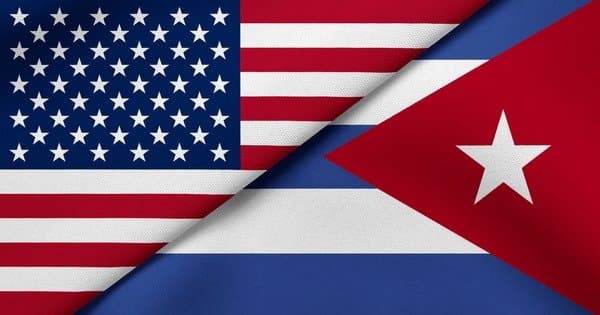
**US-Cuba relations in 2026 feature intense US economic and diplomatic pressure without kinetic engagement.** Following the January US operation capturing Venezuelan leader Nicolás Maduro, the Trump administration imposed a fuel blockade via executive order, sanctioned third-country oil suppliers to Cuba, and designated regime change as an explicit goal, with repeated calls for Cuban leaders to “make a deal.” These measures triggered severe shortages, blackouts, and economic strain on the island. Military signaling has included stepped-up US reconnaissance flights, deployment of the USS Nimitz carrier group to the Caribbean, Marine rotations, and Pentagon contingency planning for options ranging from strikes to larger air assaults. Cuban acquisitions of Russian and Iranian drones prompted public warnings from Defense Secretary Pete Hegseth at Guantanamo Bay, while Cuba has publicly prepared for possible attack and rejected US demands. An indictment of former leader Raúl Castro and CIA contacts added to the pressure campaign. Despite the rhetoric and posturing, no direct US-Cuba military clash has occurred through mid-August. Ongoing US commitments related to Iran, the preference for maximum-pressure sanctions and negotiations over immediate force, and Cuba’s limited conventional capabilities have kept tensions below the threshold of armed confrontation. Trader consensus on “No” at 75.5% reflects the pattern of coercive diplomacy and economic isolation outpacing kinetic action in the remaining months of 2026.
Resumo experimental gerado por IA com dados do Polymarket. Isto não é aconselhamento de trading e não tem qualquer papel na resolução deste mercado. · AtualizadoConfronto militar EUA x Cuba em 2026?
Confronto militar EUA x Cuba em 2026?
Sim
$237,932 Vol.
$237,932 Vol.
Sim
$237,932 Vol.
$237,932 Vol.
A "military encounter" is defined as any incident involving the use of force such as missile strikes, artillery fire, exchange of gunfire, or other forms of direct military engagement between US and Cuban military forces. Non-violent actions, such as warning shots, artillery fire into uninhabited areas, or missile launches that land in territorial waters or pass through airspace, will not qualify for a "Yes" resolution. Intentional ship ramming that results in significant damage to (e.g., a hole in the hull) or the sinking of a military ship by another will count toward a "Yes" resolution, however minor damage (scrapes, dents) will not.
Note: the United States Coast Guard is considered part of the United States military, and the Cuban Border Guard is considered part of the Cuban military.
The resolution source for this market will be a consensus of credible reporting.
Mercado Aberto: Feb 25, 2026, 7:31 PM ET
Resolver
0x65070BE91...A "military encounter" is defined as any incident involving the use of force such as missile strikes, artillery fire, exchange of gunfire, or other forms of direct military engagement between US and Cuban military forces. Non-violent actions, such as warning shots, artillery fire into uninhabited areas, or missile launches that land in territorial waters or pass through airspace, will not qualify for a "Yes" resolution. Intentional ship ramming that results in significant damage to (e.g., a hole in the hull) or the sinking of a military ship by another will count toward a "Yes" resolution, however minor damage (scrapes, dents) will not.
Note: the United States Coast Guard is considered part of the United States military, and the Cuban Border Guard is considered part of the Cuban military.
The resolution source for this market will be a consensus of credible reporting.
Resolver
0x65070BE91...**US-Cuba relations in 2026 feature intense US economic and diplomatic pressure without kinetic engagement.** Following the January US operation capturing Venezuelan leader Nicolás Maduro, the Trump administration imposed a fuel blockade via executive order, sanctioned third-country oil suppliers to Cuba, and designated regime change as an explicit goal, with repeated calls for Cuban leaders to “make a deal.” These measures triggered severe shortages, blackouts, and economic strain on the island. Military signaling has included stepped-up US reconnaissance flights, deployment of the USS Nimitz carrier group to the Caribbean, Marine rotations, and Pentagon contingency planning for options ranging from strikes to larger air assaults. Cuban acquisitions of Russian and Iranian drones prompted public warnings from Defense Secretary Pete Hegseth at Guantanamo Bay, while Cuba has publicly prepared for possible attack and rejected US demands. An indictment of former leader Raúl Castro and CIA contacts added to the pressure campaign. Despite the rhetoric and posturing, no direct US-Cuba military clash has occurred through mid-August. Ongoing US commitments related to Iran, the preference for maximum-pressure sanctions and negotiations over immediate force, and Cuba’s limited conventional capabilities have kept tensions below the threshold of armed confrontation. Trader consensus on “No” at 75.5% reflects the pattern of coercive diplomacy and economic isolation outpacing kinetic action in the remaining months of 2026.
Resumo experimental gerado por IA com dados do Polymarket. Isto não é aconselhamento de trading e não tem qualquer papel na resolução deste mercado. · Atualizado


Cuidado com os links externos.
Cuidado com os links externos.
Frequently Asked Questions