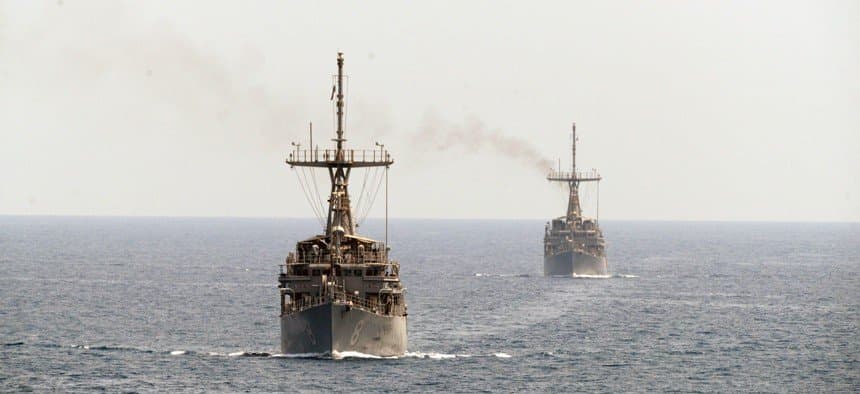
Amid escalating Iran-Israel tensions, including Tehran's April 13 drone and missile barrage and Israel's April 19 strike on Isfahan, naval transits through the Strait of Hormuz remain routine without disruption. Chinese PLA Navy vessels, such as the Jinggangshan landing ship and Qijiang frigate, passed northbound on April 11 toward joint exercises with Iran, Pakistan, and Russia—the most notable recent foreign deployment. The US 5th Fleet continues regular passages from its Bahrain base, exemplified by the destroyer USS Paul Hamilton's southbound transit on April 20. No confirmed plans for additional warships by April 30, but Houthi Red Sea attacks and Iranian ship seizures heighten risks of escalation or protective convoys, influencing trader assessments of participating countries like the US, UK, or European allies.
Résumé expérimental généré par IA à partir des données Polymarket · Mis à jourWhich countries will send warships through the Strait of Hormuz by April 30?
Which countries will send warships through the Strait of Hormuz by April 30?
États-Unis
33%
France
24%
United Kingdom
23%
India
22%
Netherlands
21%
Pakistan
21%
Japan
21%
Greece
20%
Italy
14%
Canada
11%
Germany
9%
$0.00 Vol.
États-Unis
33%
France
24%
United Kingdom
23%
India
22%
Netherlands
21%
Pakistan
21%
Japan
21%
Greece
20%
Italy
14%
Canada
11%
Germany
9%
A "warship transit" is defined as a military vessel passing through the Strait of Hormuz. Military cargo or support vessels will be considered “warships”; however, commercial or civilian vessels will not qualify.
For the purposes of this market, only transits through the Strait of Hormuz will be considered, defined as passage through the narrowest portion of the waterway between Iran and Oman. Operations solely in the Persian Gulf, Gulf of Oman, or Arabian Sea without passage through this narrowest section will not qualify.
Official confirmation by a national government or its military that its vessels transited through the Strait of Hormuz during the specified timeframe will resolve this market immediately. An overwhelming consensus of credible reporting confirming that such a transit occurred during the specified timeframe will also suffice.
Qualifying confirmations include statements such as official announcements that a country has deployed naval vessels to transit or escort shipping through the Strait of Hormuz.
Confirmations referring only to naval presence in the broader region, including the Persian Gulf, Gulf of Oman, or Arabian Sea, without confirmed transit through the Strait itself, as well as aerial operations, cyber operations, or actions by proxies or third parties, will not alone qualify.
The primary resolution source for this market will be official information by the respective national governments or their militaries; however, an overwhelming consensus of credible reporting will also suffice.
Marché ouvert : Mar 27, 2026, 1:36 PM ET
Resolver
0x65070BE91...A "warship transit" is defined as a military vessel passing through the Strait of Hormuz. Military cargo or support vessels will be considered “warships”; however, commercial or civilian vessels will not qualify.
For the purposes of this market, only transits through the Strait of Hormuz will be considered, defined as passage through the narrowest portion of the waterway between Iran and Oman. Operations solely in the Persian Gulf, Gulf of Oman, or Arabian Sea without passage through this narrowest section will not qualify.
Official confirmation by a national government or its military that its vessels transited through the Strait of Hormuz during the specified timeframe will resolve this market immediately. An overwhelming consensus of credible reporting confirming that such a transit occurred during the specified timeframe will also suffice.
Qualifying confirmations include statements such as official announcements that a country has deployed naval vessels to transit or escort shipping through the Strait of Hormuz.
Confirmations referring only to naval presence in the broader region, including the Persian Gulf, Gulf of Oman, or Arabian Sea, without confirmed transit through the Strait itself, as well as aerial operations, cyber operations, or actions by proxies or third parties, will not alone qualify.
The primary resolution source for this market will be official information by the respective national governments or their militaries; however, an overwhelming consensus of credible reporting will also suffice.
Resolver
0x65070BE91...Amid escalating Iran-Israel tensions, including Tehran's April 13 drone and missile barrage and Israel's April 19 strike on Isfahan, naval transits through the Strait of Hormuz remain routine without disruption. Chinese PLA Navy vessels, such as the Jinggangshan landing ship and Qijiang frigate, passed northbound on April 11 toward joint exercises with Iran, Pakistan, and Russia—the most notable recent foreign deployment. The US 5th Fleet continues regular passages from its Bahrain base, exemplified by the destroyer USS Paul Hamilton's southbound transit on April 20. No confirmed plans for additional warships by April 30, but Houthi Red Sea attacks and Iranian ship seizures heighten risks of escalation or protective convoys, influencing trader assessments of participating countries like the US, UK, or European allies.
Résumé expérimental généré par IA à partir des données Polymarket · Mis à jour
Méfiez-vous des liens externes.
Méfiez-vous des liens externes.
Questions fréquentes