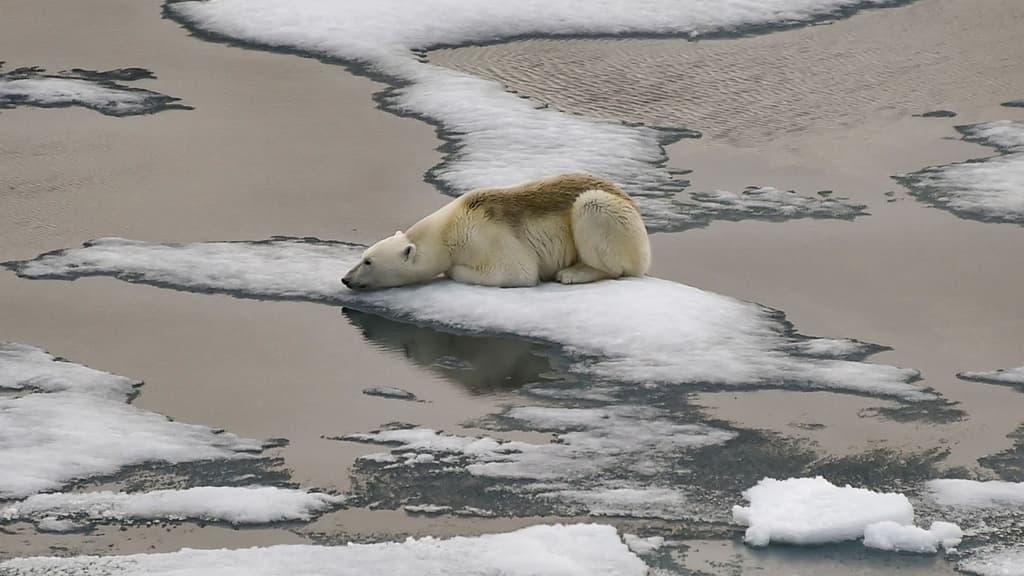
**Trader consensus centers on a 2026 Arctic sea ice minimum near 4.4–4.8 million square kilometers, reflecting the post-2010 low but stable regime rather than new record lows or recovery.** Recent late-August analyses show 2026 extent ranking around 11th–15th lowest in the satellite record, tracking closely with 2025 levels and typical post-2010 values. Melt rates have slowed as solar input declines, with the annual minimum expected in mid-September. Japanese forecasts issued in May projected ~4.49 million km² for mid-September, slightly below 2025’s NSIDC-reported minimum of ~4.60 million km². Met Office statistical outlooks from July placed September extent most likely in the 4.0–5.5 million km² post-2007 range. Key drivers include the record-low winter maximum in March 2026 (tied or just below 2025’s low), which left thinner ice especially vulnerable in the Atlantic sector, combined with persistent regional patterns of low extent on the Atlantic side versus relatively higher ice on the Pacific side. June–July weather featured stormy conditions that influenced melt but did not produce extreme compaction or heat. Long-term anthropogenic warming continues the multi-decadal decline, yet September minima have shown little trend since ~2007, with interannual variability now dominated by summer atmospheric patterns. Market-implied probabilities align with this evidence-based range: the 4.4–4.6 million km² bin leads because current trajectories and ensemble forecasts cluster there, while lower bins (<4.2) would require unusually rapid late-summer melt and higher bins (>4.8) would need sustained cooler or stormier conditions atypical of recent years. Updated model runs and NSIDC/NSIDC-equivalent observations through early September remain the key near-term catalysts.
Eksperymentalne podsumowanie AI odwołujące się do danych Polymarket. To nie jest porada handlowa i nie ma wpływu na rozstrzyganie tego rynku. · ZaktualizowanoMin Arctic sea ice extent this summer?
Min Arctic sea ice extent this summer?
4.4-4.6m sq km 65.2%
4.6-4.8m sq km 23.5%
4.2-4.4m sq km 10.8%
4.8-5m sq km 2.6%
$70,991 Wol.
$70,991 Wol.
<4m sq km
3%
4.0-4.2m sq km
2%
4.2-4.4m sq km
11%
4.4-4.6m sq km
65%
4.6-4.8m sq km
24%
4.8-5m sq km
3%
5m+ sq km
2%
4.4-4.6m sq km 65.2%
4.6-4.8m sq km 23.5%
4.2-4.4m sq km 10.8%
4.8-5m sq km 2.6%
$70,991 Wol.
$70,991 Wol.
<4m sq km
3%
4.0-4.2m sq km
2%
4.2-4.4m sq km
11%
4.4-4.6m sq km
65%
4.6-4.8m sq km
24%
4.8-5m sq km
3%
5m+ sq km
2%
This market will remain open until data has been published for October 1, 2026, at which point it will resolve immediately. Any revisions to sea ice extent recorded after data is published for October 1, 2026 will not be considered.
The resolution source for this market measures temperatures to thousands of square kilometers (e.g. 4.255 million sq km). Thus, this is the level of precision that will be used when resolving the market.
The resolution source for this market will be information from the National Snow and Ice Data Center, specifically the minimum value recorded for any day between August 1, 2026 and October 1, 2026 in the “NH-Daily-Extent” tab of the “Sea Ice Index Daily Extent” data set, available at https://nsidc.org/sea-ice-today/sea-ice-tools. If this resolution source becomes unavailable, another resolution source will be chosen.
Rynek otwarty: Nov 20, 2025, 6:43 PM ET
Rozstrzygający
0x2F5e3684c...This market will remain open until data has been published for October 1, 2026, at which point it will resolve immediately. Any revisions to sea ice extent recorded after data is published for October 1, 2026 will not be considered.
The resolution source for this market measures temperatures to thousands of square kilometers (e.g. 4.255 million sq km). Thus, this is the level of precision that will be used when resolving the market.
The resolution source for this market will be information from the National Snow and Ice Data Center, specifically the minimum value recorded for any day between August 1, 2026 and October 1, 2026 in the “NH-Daily-Extent” tab of the “Sea Ice Index Daily Extent” data set, available at https://nsidc.org/sea-ice-today/sea-ice-tools. If this resolution source becomes unavailable, another resolution source will be chosen.
Rozstrzygający
0x2F5e3684c...**Trader consensus centers on a 2026 Arctic sea ice minimum near 4.4–4.8 million square kilometers, reflecting the post-2010 low but stable regime rather than new record lows or recovery.** Recent late-August analyses show 2026 extent ranking around 11th–15th lowest in the satellite record, tracking closely with 2025 levels and typical post-2010 values. Melt rates have slowed as solar input declines, with the annual minimum expected in mid-September. Japanese forecasts issued in May projected ~4.49 million km² for mid-September, slightly below 2025’s NSIDC-reported minimum of ~4.60 million km². Met Office statistical outlooks from July placed September extent most likely in the 4.0–5.5 million km² post-2007 range. Key drivers include the record-low winter maximum in March 2026 (tied or just below 2025’s low), which left thinner ice especially vulnerable in the Atlantic sector, combined with persistent regional patterns of low extent on the Atlantic side versus relatively higher ice on the Pacific side. June–July weather featured stormy conditions that influenced melt but did not produce extreme compaction or heat. Long-term anthropogenic warming continues the multi-decadal decline, yet September minima have shown little trend since ~2007, with interannual variability now dominated by summer atmospheric patterns. Market-implied probabilities align with this evidence-based range: the 4.4–4.6 million km² bin leads because current trajectories and ensemble forecasts cluster there, while lower bins (<4.2) would require unusually rapid late-summer melt and higher bins (>4.8) would need sustained cooler or stormier conditions atypical of recent years. Updated model runs and NSIDC/NSIDC-equivalent observations through early September remain the key near-term catalysts.
Eksperymentalne podsumowanie AI odwołujące się do danych Polymarket. To nie jest porada handlowa i nie ma wpływu na rozstrzyganie tego rynku. · Zaktualizowano

Uważaj na linki zewnętrzne.
Uważaj na linki zewnętrzne.
Często zadawane pytania